
Why London Businesses Need Professional Web Design

More than 80% of customers check out a business online before buying. In London, this research is fast, with many tabs open. A weak site can make a business seem risky, even if it’s great.
For many local firms, their website is the first chance to impress new customers. Before any contact, the design and content set expectations. This is why professional web design in London is key for small and medium businesses.
Good web design is more than just colours and fonts. It’s about structure, clear paths, fast loading, and layouts that everyone can use. It also boosts search visibility and encourages visitors to take action.
The difference between professional web design and DIY or outdated sites is clear. London customers quickly notice cluttered, slow, or unclear sites. Brands that enhance their online presence tend to get more enquiries because it’s easy for visitors to take the next step.
This article will compare professional web design with template-based fixes and old sites. We’ll show how design choices affect outcomes like leads, bookings, and repeat business. You’ll learn when to redesign and when to start fresh.
Key takeaways
- A London website often acts as the first sales conversation, shaping trust before any contact.
- professional web design London supports credibility in a market where customers compare options quickly.
- web design services london cover UX, performance, accessibility, and SEO-ready structure, not just visuals.
- Strong business web design london reduces friction and helps visitors move towards an enquiry or booking.
- Efforts to improve online presence london are more effective when design and content work together.
- The sections ahead focus on outcomes, with clear guidance on investment and decision-making.
Why first impressions matter for a business website London
In London, people move quickly and compare options fast. A business website in London has just a moment to show it’s clear, current, and worth a call. If it feels uncertain, they leave and keep looking.
First impressions come from what’s seen first: a simple promise, a clear service area, and a next step that makes sense. When website design in London is well-planned, visitors can scan, understand, and act easily.
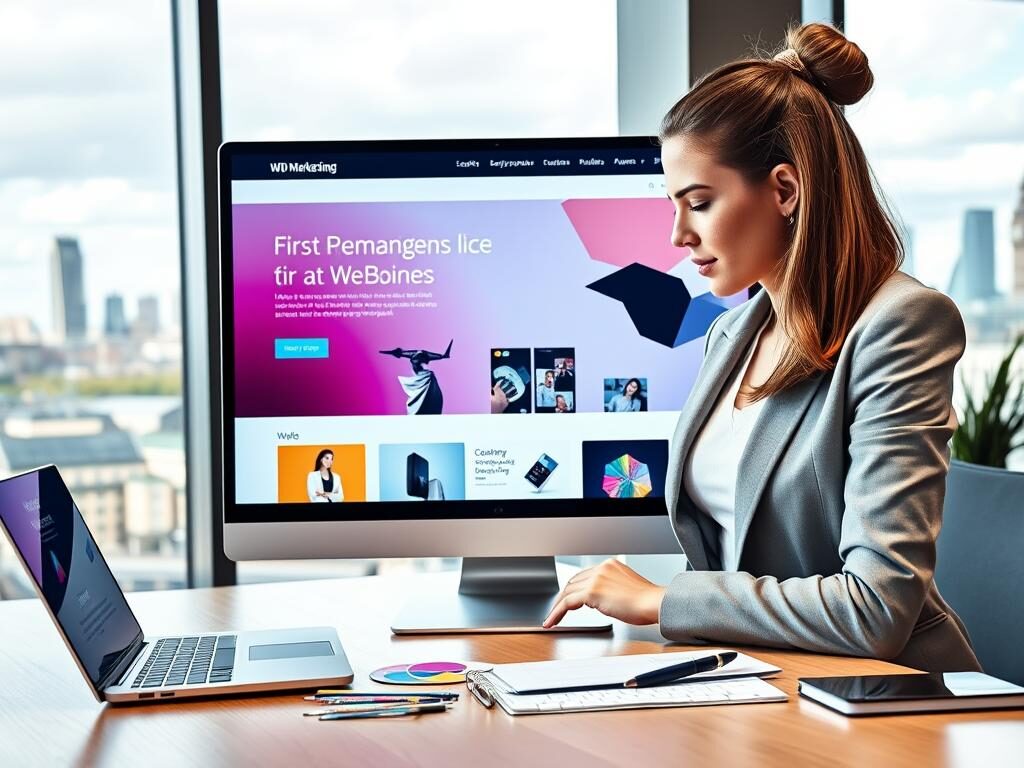
What London customers judge in the first few seconds
They look for answers to three questions: what it does, who it helps, and how to get in touch. On a small business website in London, this means a strong headline, a short supporting line, and an obvious menu that doesn’t confuse them.
They also check for signs of legitimacy. A real address, opening hours, and a working phone number can boost website credibility in London before a single paragraph is read.
- Clear service list and location cues (boroughs, travel radius, or London-wide)
- Easy navigation with predictable labels
- Contact options that are visible on every key page
Design signals that influence trust and buying decisions
Trust comes from small details that feel consistent. Clean spacing, readable type, and steady colours suggest care and stability, which supports website credibility in London’s crowded markets.
Visitors also look for proof. Reviews, short testimonials, case studies, and accurate client logos (only when genuine) reduce doubt. Secure browsing (HTTPS) and clear privacy and cookie policies make a business website in London feel safe, which is important when forms are involved.
| First-impression signal | What visitors assume | Impact on actions |
|---|---|---|
| Clear headline and service summary near the top | The business understands its offer and the customer’s problem | More scrolling and higher enquiry intent |
| Readable typography and steady spacing | Professional standards and attention to detail | Longer time on page and better comprehension |
| Visible phone, email, address, and hours | Established, reachable, and accountable | More calls, direction requests, and form starts |
| Testimonials, reviews, and case studies | Others have used the service with good outcomes | Lower hesitation and stronger decision confidence |
| HTTPS, privacy policy, and cookie controls | Data is handled responsibly | Higher form completion and fewer drop-offs |
How poor visuals and clutter increase bounce rates
Clutter raises effort. Mixed fonts, loud colours, and stock-heavy images can make a small business website in London feel generic, even when the service is excellent.
Bounce rates rise when visual hierarchy is weak, pop-ups block the view, or hero images load slowly. If calls to action are vague, visitors go back to Google and pick a competitor with clearer website design in London.
A deliberate layout reduces uncertainty by guiding the eye from message to proof to contact. This structure supports website credibility in London and keeps the path to enquiry simple.
DIY sites vs professional websites in London: credibility, trust and growth
DIY builders can quickly set up a business website in London. This is great for early testing. But, in London’s markets, customers often compare several firms at once. Small design cues can greatly affect who feels safe to contact.

Common weaknesses of templates and do-it-yourself builders
Tools like Wix, Squarespace, and WordPress templates are quick. But, they often look too familiar. This can make a brand blend in, which is a problem in busy markets.
- Generic layouts that hide the real offer and make messaging vague
- Inconsistent spacing and typography that reads as rushed
- Limited journey design, so key pages are hard to reach in two clicks
- Plugin bloat that slows pages and adds small bugs
- Cookie and privacy gaps that weaken trust at first glance
- Poor content structure that dulls SEO signals and readability
DIY builds can also stall when teams want new features. At this point, web design services in London focus on removing friction rather than adding new features.
Signals of reliability
A professional website in London usually feels calm and consistent. It uses a bespoke layout that matches the brand. It has predictable buttons, clear headings, and microcopy that answers common worries.
When a firm hires a web designer in London, the work includes making the site accessible. It also includes readable contrast and purposeful imagery. Technical choices matter too, like tidy code and stable hosting.
For brands comparing partners, a curated portfolio like web design services in London shows how structure and tone change across industries. It does so without losing clarity.
Credibility that supports long-term growth
Stronger trust improves enquiry rates and helps filter better-fit leads. It also boosts referral confidence, making it easier to share links without apology.
A business website in London built for growth can scale content and add new pages. It can track conversion events across different channels. DIY sites may work for early testing, but they often plateau when the business needs faster testing and ongoing optimisation.
| Area | DIY builders and templates | Professional build approach | Impact on trust and growth |
|---|---|---|---|
| Brand distinctiveness | Common patterns and stock sections that look familiar | Tailored layout, imagery, and tone aligned to the brand | Clearer recall and stronger confidence on comparison |
| Messaging and structure | Pages added over time, with uneven hierarchy | Planned information architecture and scannable content | Faster understanding, fewer drop-offs |
| User experience | Limited control over journeys and edge cases | Purposeful flows for calls, forms, and key actions | More consistent enquiries and higher lead quality |
| Performance | Extra apps and heavy themes can slow load | Optimised assets, lean code, and measured performance | Better engagement, fewer abandoned visits |
| Compliance and reassurance | Cookie banners and policies often inconsistent | Cleaner consent handling and clearer trust cues | Less hesitation at the point of contact |
| Marketing scalability | Harder to add targeted landing pages and tracking | Room for new pages, testing, and event tracking | Stronger results from campaigns over time |
Mobile-first success with responsive website design London
In London, people often search while they are on the move. They compare providers on the Tube, between meetings, or while walking to a job. For a small business website london, the mobile view is the first impression, not the desktop.
Good website design london puts the essentials upfront. This includes what the business does, where it operates, and how to get in touch. When this is clear on a phone, visitors are more likely to act.

Why mobile responsiveness is essential for London audiences
London customers expect pages to fit their screen without pinching and zooming. If the menu is tiny or the text is cramped, they tend to back out and try the next result.
With professional web design London, mobile pages can guide people fast. They show services, pricing, service areas, and a simple way to call or message. This supports local intent, where speed and clarity matter more than extra pages.
Responsive layouts, accessibility and modern usability expectations
Responsive means more than a shrinking layout. It should adapt cleanly across devices, with touch-friendly buttons, readable type, and forms that work well on thumbs.
- Navigation stays simple, with tap targets that do not cause mis-clicks.
- Text remains legible, with line spacing that supports scanning.
- Forms use clear labels and easy input types, so users can complete them quickly.
- Accessibility includes strong contrast, descriptive link text, clear focus states, and a sensible heading structure.
These details help everyone, including people using assistive technology or older phones. They also reduce errors that can quietly drain leads.
How mobile UX impacts enquiries and conversion rates
Mobile UX affects whether someone calls, requests a quote, or asks for directions. If the phone number is hard to find, the page jumps while loading, or the form feels fiddly, many will abandon and choose another London competitor.
| Mobile moment | What strong mobile UX provides | What often happens with DIY or outdated builds | Likely outcome |
|---|---|---|---|
| Quick provider check during a commute | Clear services, visible contact actions, fast load | Heavy pages, vague headings, key info buried | Short visit and exit |
| Calling for availability or pricing | Tap-to-call placed near the top, consistent header | Number hidden in the footer or inside an image | Fewer calls |
| Requesting a quote on a phone | Short form, clear labels, minimal scrolling | Long form, tiny fields, confusing errors | More drop-offs |
| Checking service areas before booking | Readable areas list, simple directions action | Endless sections and scattered location details | Lower trust and fewer bookings |
For responsive website design london done well, every screen supports a clear next step. This is where a small business website london can turn casual browsing into real calls, bookings, and enquiry forms, without forcing people to fight the page.
Speed and performance: modern website design London that keeps users engaged
In London, people quickly compare options. If a page is slow, they leave before it loads. Modern website design in London values speed as much as design and content.
Good website development in London makes sites smooth on all devices. It also ensures easy browsing, even on slow networks. Teams see speed as a key feature, not just a final touch.
Why website speed affects user behaviour and lead quality
Fast sites keep visitors interested long enough to see what you offer. This leads to more serious enquiries. People are more likely to take action if they stay engaged.
Slow sites lose potential customers early. They might attract people who don’t really want to buy. For web design in London, fast sites mean better leads.
Performance optimisations: images, code, caching and hosting
Improving performance is about small wins. A top website in London uses quick-loading assets and code. It stays fast even when adding new content.
- Images: use modern formats like WebP or AVIF, compress, and size for mobiles.
- Code: minify CSS and JavaScript, use fewer plugins, and remove unused scripts.
- Caching and delivery: use browser and server caching, and a CDN if needed.
- Hosting: choose reliable UK hosting, solid TLS, and support for HTTP/2 or HTTP/3.
Many London firms focus on UX gains. Some updates have boosted conversions by up to 200%. More details are in professional website design London advice, where speed is key.
Balancing visual impact with fast load times
Design teams use performance budgets to keep sites lean. They choose efficient media and animation that doesn’t slow mobile scrolling.
This balance is crucial for brands wanting to look good without slowing down. London’s website development ensures sites are both beautiful and fast.
| Performance area | What is tuned | Practical effect on visitors | Ongoing check |
|---|---|---|---|
| Images and media | WebP/AVIF, compression, responsive sizes, lazy loading | Faster first view, less data use on mobile | New uploads reviewed so banners and case studies stay light |
| Front-end code | Minified CSS/JS, fewer third-party scripts, reduced plugin load | Smoother scrolling, fewer stalls during interaction | Script audits when marketing tags and tools change |
| Caching and delivery | Browser caching, server caching, CDN where suitable | Quicker repeat visits and more consistent load times | Cache rules checked after releases and content updates |
| Hosting and protocol | UK-optimised hosting, TLS, HTTP/2 or HTTP/3, server response time | Faster connections, fewer timeouts at peak times | Monitoring uptime and response time as traffic grows |
Improving performance is an ongoing task. As content and tools change, teams keep an eye on speed. This approach keeps websites fast, usable, and competitive.
SEO-friendly foundations with seo friendly website london structure
A site can look sharp but still struggle to rank. For many firms, website design london works best when it is built on clean, crawlable foundations.
A well-planned business website london helps search engines read each page with less effort. This clarity supports steadier visibility and can help improve online presence london in competitive search results.
Technical SEO essentials: clean code, indexing and site architecture
Strong structure starts with a simple page hierarchy and clear navigation. Clean URLs, correct canonicalisation, and an XML sitemap make it easier for pages to be discovered and grouped properly.
Robots directives should prevent wasted crawl time on duplicates and thin templates. Where it fits, schema markup such as LocalBusiness can also add context around services and location.
DIY builds often leave behind indexation traps, like repeated pages and messy parameter URLs. A professionally built seo friendly website london setup avoids those faults and stays easier to maintain as the site grows.
On-page SEO structure: headings, internal links and content layout
On-page structure is about making content easy to scan and understand. Headings should follow a clear order, with short sections that match how people read on mobile.
Internal links work best when they reflect real service priorities, not random clicks. Consistent page templates also help a business website london expand into new services without losing clarity or tone.
| Area | DIY build outcome | Professional build outcome |
|---|---|---|
| Heading hierarchy | Mixed levels, repeated headings, unclear page topics | Logical structure that supports readers and relevance signals |
| Internal linking | Few links, weak pathways to key services | Planned routes to priority pages and supporting content |
| Index control | Duplicate pages and thin templates indexed by mistake | Cleaner canonicals, sitemaps, and controlled crawl paths |
| Local context | Generic copy with little area intent | Service pages aligned to London needs and search language |
Local visibility: supporting London searches and location intent
Local intent is often clear in searches for services across boroughs and neighbourhoods. Accurate NAP details, useful map embeds, and consistent information that matches a Google Business Profile can support local pack visibility.
When website design london is aligned with real service areas, the site can match “near me” and borough-based searches with more precision. This helps improve online presence london by attracting visitors who are ready to enquire, not just browse.
In practice, the seo friendly website london approach connects visibility with user flow. It brings qualified traffic to a business website london and guides them towards the next step with fewer distractions.
Conversion-focused design that generates more enquiries for London SMEs
For many London SMEs, a good website is not just about getting more visitors. It’s about getting more actions, like calls, quote requests, and bookings. This is why web design in London often starts with the user’s journey, not just the look.
A website that removes doubt and delay guides visitors to take action easily. Good web design services in London focus on what visitors need to decide and make it simple to do so.
Clear calls to action and enquiry pathways that reduce friction
London buyers scan quickly, often on mobile, and expect clear ways to contact. A strong page has one main call to action and avoids too many buttons. This makes the site feel “quiet” in a good way, with fewer choices and clearer outcomes.
Trust cues work best near the action moment. Short reviews, relevant accreditations, and a clear process summary support the click without slowing it down. Navigation is key; if important pages are hard to find, the lead is lost.
Landing pages, forms and click-to-call best practice
Landing pages work best when the message matches the visitor’s intent. If someone searched for an emergency service, the page should address urgency and next steps first. In London, local proof, like service areas and practical details, helps too.
Forms should only ask for what’s needed to respond well. Name, contact method, and one clear question are often enough. On mobile, click-to-call must be obvious, with tap-friendly numbers and clear error messages if a form field is missed.
Some sites add WhatsApp or live chat, but it only helps if it’s managed. A “dead” chat widget can damage trust faster than having no chat at all. Many web design services in London place chat as a secondary option, after phone and form.
Measuring performance: analytics, heatmaps and continuous improvement
Many DIY or outdated sites can’t show what works because they track nothing. A modern business website in London should log real actions, like calls and form sends. This way, decisions are based on evidence, not guesswork. That’s why professional web design in London often includes structured tracking from the start.
Heatmaps and session recordings can show where users hesitate or scroll past key points. With this insight, teams can adjust layout, tighten copy, and improve load time on high-value pages. For examples of conversion-led builds for small firms, website design services for small business shows how design and performance can support measurable enquiries.
| Conversion element | DIY or outdated approach | Conversion-focused approach for London SMEs | What it improves |
|---|---|---|---|
| Primary call to action | Several buttons with mixed wording | One clear CTA per page, repeated in logical spots | Click-through rate and enquiry volume |
| Contact access | Phone hidden on a contact page | Persistent contact options and tap-to-call on mobile | Speed to contact and lead quality |
| Forms | Long forms with optional fields presented as required | Short forms, clear validation, privacy reassurance | Form completion rate and fewer drop-offs |
| Landing page structure | Generic copy that does not match search intent | Problem → solution → proof → process → CTA, with local relevance | Ad efficiency and organic conversion |
| Trust proof near action | Reviews buried or missing context | Relevant proof placed beside CTAs and next steps | Confidence and decision speed |
| Measurement | No events, no call tracking, no insight into failures | GA4 events plus heatmaps to guide iteration | Continuous improvement over time |
Brand consistency and custom website design london for competitive advantage
Brand consistency is more than just a logo. It’s about the tone, typography, colours, and even how buttons work. When everything matches, websites feel calm and familiar.
In London, a crowded market needs strong cues. For services and consultancies, a consistent website can look established. It can make a good first impression, even before a call is made.
Custom designs help a brand stand out. They can show how a business sells and proves its worth. This clarity is key for complex services, reducing confusion and helping with decisions.
Trust grows with consistent patterns. These elements can boost credibility without adding clutter.
- Consistent case study pages with clear outcomes, scope, and proof
- Recognisable service layouts that answer the same core questions each time
- Professional imagery that reflects real teams, premises, or completed work
- Messaging that matches what customers experience offline
A coherent design system boosts conversion. Predictable elements reduce doubt and keep attention. This is how a website can earn valuable enquiries, showing it’s ready to deliver.
| Brand system element | What visitors notice | Business impact |
|---|---|---|
| Type scale and spacing rules | Pages feel organised and easy to scan | Lower friction on key pages and fewer missed details |
| Colour and contrast standards | Calls to action stand out without shouting | More confident clicks and clearer next steps |
| Photography and icon style | The site looks genuine and consistent | Stronger recall and improved website credibility london |
| Reusable page templates | New pages feel like part of the same brand | Faster growth across services and locations without drift |
As a business grows, a strong system is crucial. It makes adding new services or pages easier. Teams looking at custom website design london often focus on this. It helps protect the brand’s value over time.
Consistent brand cues make the experience feel thoughtful. This is what sets a professional website apart from a simple brochure. It’s key for success in London’s competitive market.
professional web design London vs website redesign london: which approach fits
For many London SMEs, the choice is less about style and more about risk, return, and timing. A website redesign london can improve look and flow fast, but only if the platform is stable. If not, the same issues will keep leaking leads, even with fresh visuals.
When a redesign is enough (and when it is not)
A redesign is right when the site has solid hosting, clean URLs, and a CMS that still receives updates. It may focus on clearer pages, better mobile layouts, sharper copy, and stronger calls to action. Done well, it keeps search value while moving the brand closer to modern website design london.
It is not enough when the CMS is old, plugins are risky, or templates load slowly and cannot be tuned. If mobile behaviour is baked into the theme, small fixes become costly. In those cases, a new build can be safer than repeated patches.
Signs an outdated site is costing leads and damaging credibility
Outdated sites often fail in quiet ways. Visitors leave when pages feel hard to use, forms break, or contact details are buried. If the site lacks HTTPS, looks inconsistent, or has dead pages, trust drops quickly.
- Rising bounce rate from key landing pages
- Low mobile conversion and short session times
- Confusing navigation and weak page hierarchy
- Old imagery and mixed branding across pages
- Broken links, slow load times, or unreliable forms
When these signals appear, many firms choose to hire web designer london support to triage issues and map the next step.
Choosing between custom builds, CMS updates and full website development london
Options tend to fall into three routes. A custom build suits firms that need difference, speed, and a tailored user journey. A CMS update works when the structure is sound and the goal is steady improvement. Full website development london fits when technical debt is high, the platform limits growth, or services have changed.
Costs vary by scope, but professional work usually covers discovery, UX, design, development, content support, SEO setup, analytics, and QA. It is rarely just “a homepage”, whether the work starts as website development london planning or a redesign brief.
| Approach | Best fit for | What it tends to include | Watch-outs | Typical investment range (London SMEs) |
|---|---|---|---|---|
| Website redesign london | Stable CMS, strong pages, but weak UX, visuals, or copy flow | New templates or page layouts, refreshed imagery, conversion tweaks, content structure, measured UX updates | If core speed, security, or architecture is poor, the redesign may only mask deeper faults | Often £2,500–£12,000 depending on page count and complexity |
| CMS updates and retainer improvements | Sites that perform well but need ongoing tuning and support | Security updates, performance improvements, accessibility fixes, testing, small UX upgrades, tracking clean-up | Can drift without a clear roadmap; bigger rebuild needs may be delayed too long | Often £300–£1,500 per month, based on hours and service level |
| Custom build | Firms needing differentiation, bespoke journeys, and scalable features | Discovery, information architecture, bespoke UX/UI, performance-first build, content migration, QA and launch support | Requires stronger input and decisions; timelines are longer than a refresh | Often £10,000–£50,000+ depending on features and integrations |
| Full website development london | High technical debt, major service changes, or a platform that blocks growth | New platform setup, rebuilt architecture, improved SEO foundations, analytics, redirects, performance and security hardening | Migration risks if rushed; needs careful redirects and content planning | Often £15,000–£80,000+ depending on content and system needs |
In practice, many firms start with an audit, then decide whether to hire web designer london expertise for a refresh or commit to a rebuild. The right path is the one that supports reliable growth and a credible experience that matches modern website design london expectations.
Conclusion
London shoppers make quick decisions online. Professional web design in London stands out. It combines first impressions, mobile friendliness, speed, SEO, user experience, and brand consistency.
This approach leads to real results. When web design services in London make things easier, build trust, and guide visitors, more people get in touch. It also boosts online presence by matching search trends and browsing habits in the city.
For London SMEs, a website is a growth tool, not just a one-time project. Investing in quality design and ongoing updates keeps it competitive. As competitors evolve, so should your site.
Many businesses opt for web designer support in London to find site improvements. A free consultation can spot quick wins in speed, user experience, calls to action, and SEO. It decides if a redesign or rebuild is right for your goals and budget.